...for readers who love animals, and animal lovers who read!

Wednesday, July 2, 2014

Your Pet Could Be in a Mystery!

by Sheila Webster Boneham


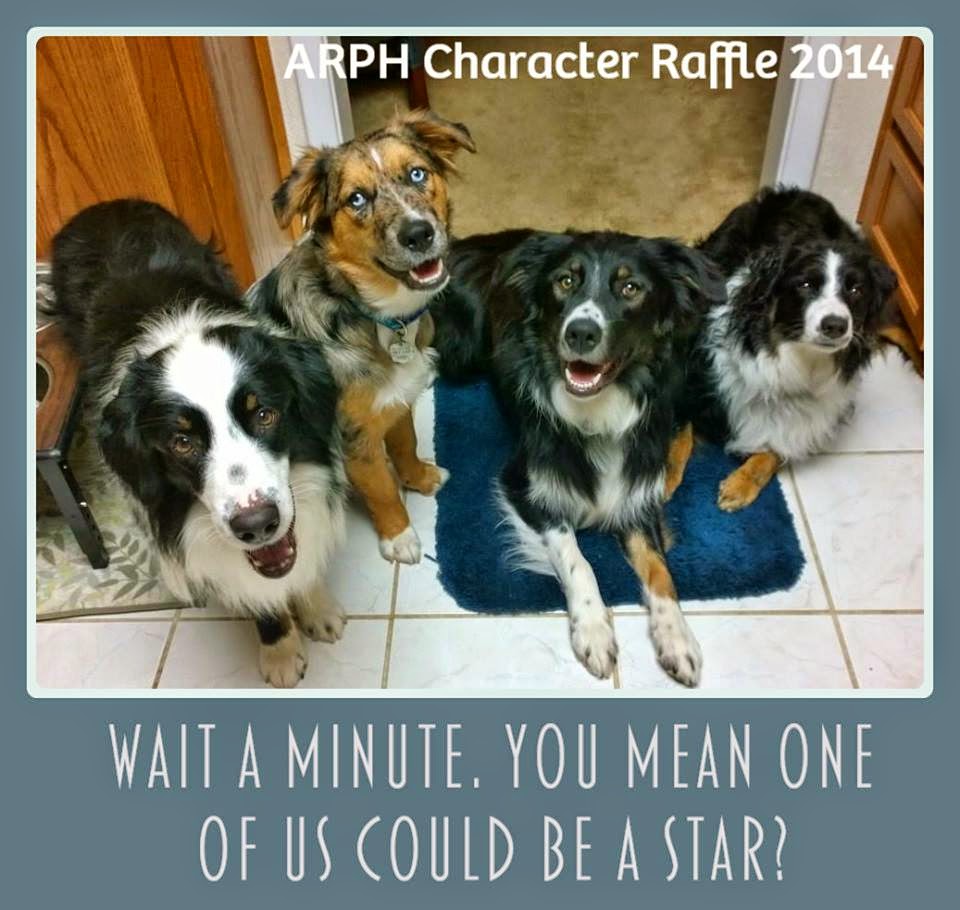
OMG, you guys!!! One of us could be a STAR!! 
Don't forget to submit your entry for the ARPH Character Raffle Fundraiser. 
The lucky winner will be featured in Sheila Boneham's fourth mystery, 
tentatively titled Shepherd's Crook
All species are welcome to enter! 
(Other than humanoids!)

Some of you may recall that I've done this before - raffled off guest roles for critters in my Animals in focus mysteries. If you would like to know about about the winners who appear in The Money Bird and Catwalk, check out Animals in Focus Mysteries Characters Help Real Animals in Need .

Here's the scoop on the current character raffle - ARPH and I would appreciate your help in getting the word out, so please share the links. Thank you!

Sheila

ARPH Benefit Character Raffle 2014


To pay for your entry, please send the money via PayPal at jagrdoggy@yahoo.com and note it's for Shepherd's Crook....


Contest – How it works:

The winner’s pet will appear in a “guest role” in Shepherd’s Crook, the fourth Animals in Focus Mystery by Sheila Webster Boneham. Winner must provide an email address and respond to Sheila’s request for further information within 48 hours of request following the drawing. Sheila will ask for at least one photo of the chosen animal, and some information about personality, abilities, etc. Click here to learn more about the series.  


What's the story in Shepherd’s Crook?

Animal photographer Janet MacPhail knows that something is seriously amiss when she and her Aussie, Jay, learn that livestock have disappeared overnight from a herding trial. Then a man dies, and Janet unwittingly photographs the thieves in action, putting herself and those she loves in the killer’s crosshairs.

A little about moi (and why I write a series with an Aussie as lead dog)

I've been involved with Australian Shepherds for more than two decades as a breeder, rescuer, competitor, judge, and fan. In addition to the Animals in Focus mystery series featuring Aussie Jay and his friends, I have written seventeen award-winning nonfiction books about dogs, cats, and rescue, including The Owner's Guide to the Australian Shepherd, Rescue Matters!, and others. 

Animals in Focus Mysteries


Drop Dead on Recall (2012)—because obedience can be murder! Winner of 2013 Maxwell Award for Best Fiction Book from the Dog Writers Association of America, and a 2012 Top Ten Dog Book, NBCPetside. 


The Money Bird (2013)—wet dogs, wildlife trafficking, and murder!


Catwalk (forthcoming fall 2014)—because agility - canine and feline! - can be deadly!


Personally autographed copies of Sheila’s books, including pre-orders of Catwalk, are available from Pomegranate Books in Wilmington, NC. Order online at http://www.sheilaboneham.blogspot.com/p/autographed-books.html or call Pomegranate Books at 910-452-1107 to place your order.

10% of your purchase from Pomegranate will be donated to support Aussie rescue or animal health foundations - your choice!

Also available online:
Powell’s Books
Barnes & Noble 
Amazon


Sunday, June 29, 2014

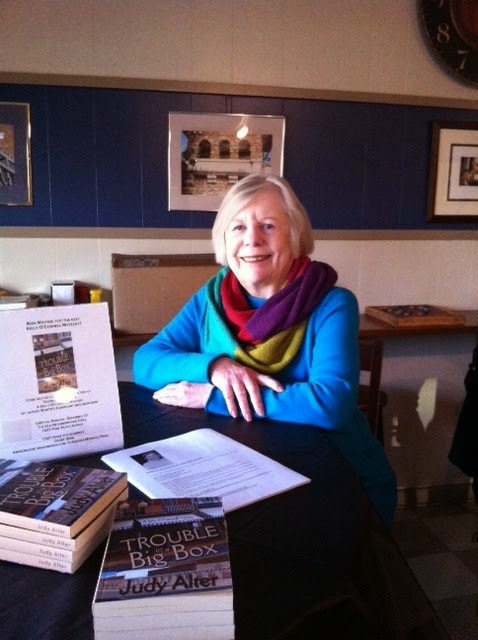
Cover Reveal! Judy Alter's Forthcoming Novel

by Judy Alter

Color me excited as I reveal the cover of my forthcoming novel, The Perfect Coed. My first venture into self-publishing will launch October 15.

Years ago—maybe ten?—I knew I wanted to write mysteries. One mystery, I told myself, and I’d be happy. So I wrote a novel I called The Perfect Coed. At the time I didn’t belong to Sisters in Crime, knew nothing about the world of mystery publishing, and even less about self-publishing, which back then still hadn’t quite lost its stigma. An agent tried to sell it, although she wanted me to turn it into a romance, and I balked.
Time intervened, but one day I told myself I read a lot of mysteries, some of them good, some of them not so good. If others could do it, so could I. So I wrote the first of my Kelly O’Connell Mysteries…and suffered all the first-book agonies: rejection by editors, a year-long wait while a small press “winnowed its list” (I’ll never do that again), and another year wasted with an agent who sent a contract and then rapidly lost interest, although he showed it to all six major NY publishers, thereby making it dead in the water for most agents. I am eternally grateful to Turquoise Morning Press for accepting Skeleton in a Dead Space, publishing it quickly,  and going on to publish five more Kelly O’Connell Mysteries and two in the Blue Plate Café series.
But times, presses, and authors change—Turquoise Morning turned more and more toward romance, I grew impatient on several fronts and wanted to try self-publishing. So I went back to The Perfect Coed, rewrote, rewrote again, finally sent it to readers, and then sent it for editing.
I followed all the steps of self-publishers—hire an editor, a designer, a formatter, and begin a marketing plan. Thanks to all the people who helped me along the way—Mary Dulle, Lourdes Venard, Lynn Stanzione, Jenn Zacek.
Now I’ve begun marketing efforts, even though the book doesn’t come out in October. But I’m as excited as a small kid waiting for Christmas. Watch for it, wait for it, and I hope you’ll read it. Here’s a blurb to pique your interest:

Susan Hogan is smart, pretty—and prickly. There was no other word for it. She is prickly with Jake Phillips and her Aunt Jenny, the two people who love her most in the world. And she is prickly and impatient with some of her academic colleagues and the petty jealousies in the English department at Oak Grove University. When a coed’s body is found in her car and she is suspected of murder, Susan gets even more defensive.
But when someone begins to stalk and threaten her—trying to run her down, killing the plants on her deck, causing a moped wreck that breaks her ankle—prickly mixes with fear. Susan decides she has to find the killer to save her reputation—and her life. What she suspects she’s found on a quiet campus in Texas is so bizarre Jake doesn’t believe her. Until she’s almost killed.
The death of one coed unravels a tale of greed, lust, and obsession.

Sophie partied a little too hard!
We’ll have a big party when The Perfect Coed comes out—it marks a new step in my writing career. But the Alters are good at celebrating—we had a birthday party last night for three dogs. My Sophie and her Cavalier King Charles Spaniel cousins. They are quiet dogs whereas Sophie, a poodle/Border Collie cross, rushes at life with excitement, which she did last night. Today she has slept all day. But she’ll be celebrating with us when the book comes out.


You can help by spreading the word, reading it, and posting reviews on Amazon and Goodreads, and I’ll be eternally grateful to you. The world of self-publishing is a big and scary one to jump into, but I’m taking the leap, and I’m excited about it.
 ****
Judy Alter is the author of five Kelly O’Connell novels—Skeleton in a Dead Space, No Neighborhood for Old Women, Trouble in a Big Box, Danger Comes Home, and Deception in Strange Places (which will launch July 31) as well as two in the Blue Plate Café Series, Murder at the Blue Plate Café and Murder at the Tremont House.
Earlier in her career she wrote a series of fictional biographies of women of the American West: Libbie (Elizabeth Bacon Custer), Sundance, Butch and Me (Etta Place, the Sundance Kid’s girlfriend and the Hole in the Wall Gang), Cherokee Rose (based on the life of cowgirl Lucille Mulhall), and Mattie (based on the life of pioneer woman physician Georgia Arbuckle Fix). And she has written many books, fiction and nonfiction, for young readers

Judy is retired as director of Texas Christian University Press and is the single parent of four grown children and the grandparent of seven. She lives in Fort Worth, Texas with her biggest fan, Sophie, her Border Collie x Poodle cross.

Wednesday, June 25, 2014

Excerpt from Murder Strikes a Pose by Tracy Weber


Excerpt from
Murder Strikes a Pose

by Tracy Weber
Midnight Ink, 2014

Author's note: In this excerpt, Kate is at home late at night after finding her homeless friend George’s body. She has taken Bella, the victim’s dog, home to stay with her until the police locate his family. Kate feels guilty over a fight she had with George earlier that day.  


I looked at the clock and almost cried. It was one-thirty, and my early morning class started at six. I’d never felt so bone-weary in my life. My head still throbbed, and my stomach ached from hunger. But all I could think about was sleep—deep, dreamless sleep. “Come on, Bella. It’s bedtime.” I showed her the bedroom. She hopped on the bed and flopped down, lying squarely on my pillow.
“Sorry, pooch. This is where I draw the line. I sleep on the bed. You sleep on the floor.”
I grabbed a blanket from the closet, laid it on the floor and pointed to it. “For you.” It took some convincing, but Bella finally relented. I collapsed on the bed and closed my eyes.
Huge mistake.
Images of George’s body, sounds of sirens, the smell of blood, and the full knowledge of the evening’s horror invaded every crevice of my being.
Bella paced the room, panting and whining. I tried to coax myself to sleep with “Kate’s Sleeping Pill,” my favorite breath practice for insomnia. No good. The horrible memories refused to leave. But at least now the room was quiet. At least that infernal whining had stopped.
My mind froze. My eyes flew open. Why had the whining stopped?
I rolled over and locked eyes with Bella. Her accusing glare scolded me. We stared each other down for what seemed like an eternity. Finally, I realized what was bothering her. Bella was used to sleeping on the ground, but not alone. She and George had lain next to each other every night for as long as she could remember. Changing that now seemed cruel.
“OK, you win. Come on up, but only for tonight.” I slapped the bed beside me.
Bella hopped up, turned a quick circle, and sank down next to me with a heavy sigh. Her brow furrowed, her ears drooped, and her head hung low. I could tell she knew something had changed. She didn’t know what or why, but she knew it was bad. Frighteningly bad. Life-changingly bad.
I suspected Bella couldn’t understand me, but she deserved an explanation nonetheless. So I told her that George was gone, but that he had loved her more than anything. I also promised her that, although I couldn’t keep her, I would make sure she was safe until I found someone who could.
I owed that to George.
You see, I firmly believed that George’s death was at least partially my fault. That if I had listened more and judged less, I might have prevented this awful night. I deeply regretted my stubbornness in not apologizing. I regretted suggesting he euthanize Bella. I even regretted not buying that damned paper. No one else would have blamed me for what happened, but I definitely blamed myself.
As I finished the story, Bella rested her chin on my belly, closed her eyes, and fell asleep. The warmth of her body on mine felt oddly comforting, and I finally relaxed enough to do what I’d needed to do for hours. I broke down sobbing as I held Bella and allowed her rhythmic breathing to rock us both to sleep.
~~~~~~~~~~~~~~
Murder Strikes a Pose introduces Kate Davidson, a feisty Seattle yoga instructor who’s more interested in savasana than solving crimes, until she stumbles over a body in the studio’s parking lot. The police dismiss the murder as drug-related street crime, but Kate knows that George—a homeless alcoholic she had befriended—was no drug dealer.
 Kate stretches herself and takes on two new challenges. First, solve George’s murder. Second, find someone—anyone—willing to adopt his intimidating, horse-sized German shepherd, Bella, before Animal Control sends her to the big dog park in the sky. But with Bella’s time almost up and the murderer hot on her trail, Kate will have to work fast, or the next time she practices corpse pose, it may be for real MURDER STRIKES A POSE is available now on Amazon, http://www.amazon.com/Murder-Strikes-Pose-Downward-Mystery/dp/0738739685/ and wherever books are sold.
 
Tracy Weber is a certified yoga teacher and the founder of Whole Life Yoga, an award-winning yoga studio in Seattle, where she currently lives with her husband and German shepherd. Weber is a member of the Pacific Northwest Writers Association, Dog Writers Association of America, and Sisters in Crime. She loves sharing her passion for yoga and animals in any form possible. Murder Strikes a Pose is Weber’s debut. For more information, visit her online at http://TracyWeberAuthor.com  or friend her on Facebook at https://www.facebook.com/tracywe


Sunday, June 22, 2014

The Making of a Book Cover

Animals in Focus #1 won the 
2013 Maxwell Award for Fiction
from the Dog Writers Association
of America and was an NBCPetside
Top Ten Dog Book of 2012.
by Sheila Webster Boneham

Forget the maxim "you can't judge a book by it's cover," even if it's true. The fact is that readers do make initial, often subconscious, judgments based on cover art and design. 

Although some book covers fail miserably in their mission, many others tell us a lot about what we can expect when we open a book. Some of them scream genre. Bare-chested square-jawed muscle-bound fella embracing fair maiden? Romance! Smoking gun, shadowy figure in fedora, sprawed body? Noir detective novel. Cowboy on horseback riding into the sunset? You get my point.

Many readers don't realize that authors rarely have much, if any, say about their covers. I've been lucky with my mysteries because editor Terri Bischoff at Midnight Ink has given me considerable input into the covers that wrap the pages of my books, and the artists and designers have taken my ideas and made them work. 


The series now has a consistent look that is, I think, attractive, and that says "mystery, animals, amateur sleuth, sports." Each cover shows the animal activity that is central to the book, and each shows at least one of the animals who take a leading role. The dogs are realistic, and as an award-winning writer of nonfiction about dogs and cats and a long-time rescuer/breeder/ competitor/animal advocate, that was important to me. Are the covers perfect? Of course not. I think the logo (it's the lens of a camera, if you can't tell - I couldn't for a while!) should be bigger. The dogs in the background of Drop Dead on Recall aren't quite right. But I love the brightness of the covers, and don't the dead bodies just howl "mystery"?


Since blogger extraordinaire Lori Caswell was kind enough to reveal the cover of Animals in Focus #3, Catwalk, last Monday, I thought I would tell you a bit about how that cover came to be. To set the scene, here's a summary of the plot....
Animal photographer Janet MacPhail is training for her cat Leo’s first feline agility trial when she gets a frantic call about a “cat-napping.” When Janet and her Australian Shepherd Jay set out to track down the missing kitty, they quickly find themselves drawn into the volatile politics of feral cat colonies, endangered wetlands, and a belligerent big-shot land developer. Janet is crazy busy trying to keep up with her mom’s nursing-home romance, her own relationship with Tom and his Labrador Retriever Drake, and upcoming agility trials with Jay and Leo. But when a body is discovered on the canine competition course, it stops the participants dead in their tracks—and sets Janet on the trail of a killer.
Because Janet will be competing this time with both her dog, Jay, and her cat (her cat!) Leo, I wanted to include both of them on the cover, and I wanted the cover to "speak agility" to my fans who know the sport. Because the title, Catwalk, is a play on "dogwalk," a canine agility obstacle, and because the plot involves feral cats and a feline TNR (trap-neuter-release) program, I wanted a cat on a dogwalk. I also wanted a dead body in an agility tunnel, and a dog sniffing it. But how could I convey my mental image to the artist? 

Clearly, I needed photos. And how do we find the people who can help us these days? Social media! So I posted on Facebook - "Does anyone have a photo of a cat on a dogwalk?" and a mini-minute later, I had a message from photographer Brenna Spencer asking what I needed and offering to stage the photo. She grabbed  Rhonda Calhoun Mullenix, her business partner at Lumos PhoDOGraphy, and here's what they came up with: 


How fantastic is that? Then I needed an image of an Australian Shepherd sniffing at the corpse, so I asked again on Facebook. Voila! My long-time friend Nita Gandara sent me this photo taken by Doug Smith of Wysiwyg Photography in Arizona: 


Jay, the lead dog in the series, is based on my own beloved Jay (with more than a few traits borrowed from other Aussies in my life), so naturally I hoped that the dog on the book would look like the real-life Jay, pictured here:
My beautiful Jay.


Jay competing in obedience.


In addition, Leo, animal photographer and amateur sleuth Janet MacPhail's cat, is an orange tabby, not a tortoiseshell. He's inspired by the cats of my life, especially Leo and Malcolm. 

Real-life Leo.


I sent the images on to Terri, and she passed them to illustrator Gary Hanna, who translated the photos into art, and cover designer Lisa Novak, who did a brilliant job of putting it all together. And, in case you haven't seen it yet, here it is!


Personally autographed copies of Sheila’s books, including pre-orders of Catwalk, are available from Pomegranate Books in Wilmington, NC. Order online at http://www.sheilaboneham.blogspot.com/p/autographed-books.html or call Pomegranate Books at 910-452-1107 to place your order.
Also available online:
Powell’s Books
Barnes & Noble 
Amazon


Wednesday, June 18, 2014

Kerchew! Thoughts from the Other Side of the [Animal] Pen

by Jenny Milchman


This might sound strange, given the subject of this blog, but I am not an animal lover. Before you start to dislike me, or at least view me with the kind of uncomprehending huh that most people feel when someone makes the confession I just did, please hear me out.

Animals make me sick. Physically sick, that is. And I don’t just mean a few sneezes, take-a-Claritin kind of sick, I mean laid out for days. I remember going on a romantic getaway with my then-fiancé and deciding to try horseback riding. Sometime in the middle of our ride, I became so weak that I nearly fell off my horse. I had to be taken back to the inn, and I didn’t get out of bed until it was time to go back home. Goodbye, getaway.

When I was very young we had two cats and although I was frail and sickly, I didn’t have the typical allergic symptoms and my parents didn’t realize what was causing the problem. One day I crawled underneath my crib and collapsed. Our apartment had to be vacated for days, and my beloved Andrew, who used to let me tow him around in a sled, got adopted by a kindly neighbor who probably didn’t harass him nearly as much as I did.

So, you see, once upon a time, I was an animal lover. In the years that followed, I became a writer, and animals found their way into my books in ways I couldn’t predict. I think it was my attempt at sublimating all those years and pets I had to go without. In my debut novel, Cover of Snow, there’s a black Lab named Weekend. I get a lot of questions about Weekend’s name, and this is the story I tell of how it came about.

I was on a beach with my husband, my brother, and some friends. We were all in our twenties, doing the kinds of things you do at night on a beach when you’re that age. Bonfire hissing, drinks being poured. And re-poured. Suddenly this guy and his dog come along, and I hear the guy call, “Weekend! Here, boy,” or words to that effect, as he clapped his hands.

In that expansive way assorted libations can instill, I stumbled through the sand to admire this dog—from a sneeze-free distance.

“Great name,” I told his owner.

The guy looked blankly at me.

“Your dog,” I explained. “I love his name.”

“Oh,” the guy said. “Really?” And then he added, “Fido?” Or Rover, or something so unoriginal that probably few people—tipsy or not—had ever gone out of their way to admire it.

But that was okay. I had my name—and a new character for my book.

There’s a dog in the novel I’ll publish next year, and he plays an even more pivotal role than Weekend does in my first novel. This dog was inspired by an animal I met on book tour in 2013. She belongs to a bookseller at McLean & Eakin in Michigan, and she is a rescue dog. Loveable and affable and sweet. But she has a past that nobody—animal lover or not—could bear to think about, and to this day, the dog has trouble being without the beloved folks who rescued her. She follows them all around the bookstore. When I heard this, while patting and complimenting the sweet animal, I immediately thought, What a perfect situation that would create in a book. A dog who can’t be left alone.

Wait a minute, you’re probably saying right now. Did you say you patted this dog? What about your allergies?

It’s a funny thing, but they seem to have gone away. I can be around dogs now, cats too occasionally, although I haven’t dared try horses yet. The heroine of my first novel is allergic to dogs at the beginning, and by the end she becomes Weekend’s caretaker and human.

They say life imitates art. Maybe one day I’ll have a black Lab—or a rescue dog—of my own. Till then, I’ll keep putting them in my books.


Jenny Milchman’s debut novel, Cover of Snow, was chosen as an IndieNext and Target Pick, won the Mary Higgins Clark award, and is nominated for a Barry. Jenny’s second novel, Ruin Falls, just came out and she and her family have hit the road on a 4 month/20,000 mile book tour.


Sunday, June 15, 2014

How many truly favorite books can you list?

by Judy Alter

I have a friend, longtime English professor,who maintains the measure of a book is whether or not generations to come will be reading it a hundred years from now. His nomination is the late Benjamin Capps’ The Road to Ogallala.
Albert Payson Terhune &
one of his famous Collies
As a child, I had many favorite books as I moved from age to age. As with many of my generation, my reading began with The Bobbsey Twins and The Little Colonel Stories. Then came the collies of Albert Payson Terhune, which made me spend years of my life wanting collies—I did have three—and the horses of Walter Farley, which somehow didn’t inspire me to want horses. I moved on to Nancy Drew and Cherry Ames, the nurse, and then suddenly I was enamored of Frances Parkinson Keyes and her thick books, romances really, about life on the Mississippi steamboats and in New Orleans.
Today I find I’m much more selective about favorite books, those that I think will survive the hundred-year test. I can point with certainty to three titles.
Mary Hallock Foote

The book I’ve claimed as my favorite for years is Wallace Stegner’s Angle of Repose, a novel loosely based on the life of Mary Hallock Foote. She was an illustrator, the darling of New York salons and socialites, when she suddenly left to marry a rough-and-ready California miner and raise her children in a variety of miner’s shacks from California to Idaho. Stegner was criticized for taking liberties with Foote’s life, but it makes a compelling novel, narrated by a male descendant with what sounds like the Parkinson’s that makes a person stiff-I’m still puzzling on the symbolism of that. I’ve reread this one, taught it, and found something new every time. And Foote herself was not an insignificant figure in the western movement. She was one of a handful of women who wrote fiction about the West in the early day. Her best-known novel is The Led-Horse Claim.
Scene from the movie version of
To Kill a Mockingbird
I realized one day that in claiming that as my favorite, I was leaving out a book that has made a lasting impression on generations of Americans—Harper Lee’s To Kill a Mockingbird. It’s another book in which you find new layers every time you read it. A couple of years ago I was asked to be on a multi-racial panel discussing the impact of the book. I re-read it, naturally, and was blown away by its strength and insight, by the characters of Atticus and Scout and Jeb. Then I watched the original film version and was astounded that it still managed to give depth and meaning to the book in spite of what we would now consider fairly elementary cinematography. About that time I found a copy of the book on my 14-year-old granddaughter’s bedside table. I asked how she liked it, and she said she thought it was boring. I thought I’d fall on the floor. It’s a book that I think a hundred years from now will tell people so much about culture in the American South and Americans in the fifties and sixties—and about the character of a few really good men.
Elmer Kelton
And recently, talking with people about the drought that the Southwest and California are experiencing, I hit myself in the head and wondered how I could forget Elmer Kelton’s masterful The Time It Never Rained, about the Texas drought of the 1950s. In Kelton’s rich Texas-heavy prose, we follow rancher Charlie Flagg as he goes from raising cattle to sheep to goats as the land dries up. Woven in are threads of the dangers of government help, the changing socio-economic situation in South Texas, relationships between men and women, sons and fathers, Mexicans and Anglos, and one man’s love for the land. Charlie Flagg is another of the rare really good men. I had the privilege of knowing Elmer Kelton and working with him on many projects. He used to say that many men came up to him and said, “That Charlie Flagg…he was based on me, wasn’t he?” Elmer always said he as an amalgamation of many men, including Elmer’s father, but I think there is a lot of Elmer in that timeless character.
I read voraciously, and I’ve read many books that I’d rate with five stars but these three stand out. There are other authors and titles I’m tempted to mention, but that would start me on the slipper y slope and I’d end writing a book about my favorite books. I’ll quit with my highly selective list.

~~
Other posts by Judy Alter on Writers & Other Animals ~


Before turning her attention to mystery, Judy Alter wrote fiction and nonfiction, mostly about women of the American West, for adults and young-adult readers. Her work has been recognized with awards from the Western Writers of America, the Texas Institute of Letters, and the National Cowboy Museum and Hall of Fame. She has been honored with the Owen Wister Award for Lifetime Achievement by WWA and inducted into the Texas Literary Hall of Fame at the Fort Worth Public Library.

Murder at Tremont House is the second Blue Plate Mystery from award-winning novelist Judy Alter, following the successful Murder at the Blue Plate Café. Judy is also the author of four books in the Kelly O’Connell Mysteries series: Skeleton in a Dead Space, No Neighborhood for Old Women, Trouble in a Big Box, and Danger Comes Home. With the Blue Plate Murder series, she moves from inner city Fort Worth to small-town East Texas to create a new set of characters in a setting modeled after a restaurant that was for years one of her family’s favorites.
Follow Judy at http://www.judyalter.com or her two blogs at http://www.judys-stew.blogspot.com or http://potluckwithjudy.blogspot.com. Or look for on Facebook or on Twitter where she is @judyalter.


Wednesday, June 11, 2014

ANIMALS AND MUSIC

by Kaye George

Since I’m a musician and have written a Musical Mystery, I’d like to talk about the ties between animals and music.

First, some famous popular ones. Have you seen Walt Disney’s Fantasia? Do you remember the hippos in tutus, dancing to Dance of the Hours? The goldfish swimming along with Arabian Dance? Or the dinosaurs battling through The Rite of Spring? Those are the first animals that come to mind when I relate animals to music.

In the first of my Cressa Carraway mysteries, I reference a couple of musical pieces with animals themes (chickens and sharks), but there are so many more!


For famous classical examples, Saint Saens’ Carnival of the Animals begins with the Royal March of the Lions, includes hens, roosters, asses, elephants, swans and more. It was written for fun. He tossed it off for a private performance, but today it’s one of his most-played pieces, often played for children.

Peter and the Wolf, by Prokofiev, is also played for children. But in both pieces, the animals characterized are captured perfectly by the music. The pieces are fun to listen to and totally suitable for audiences of all ages.

But beyond music written about animals, we can consider animals that make music: birds and whales. Spring is in full swing in East Tennessee right now, where I’m writing, and I am almost bombarded, out my window, by cardinals and towhees and bluebirds calling out their mating songs.  Much music is modeled after bird song: Song of the Nightingale by Stravinsky, Ballet of Chicks in their Shells (part of Pictures at an Exhibition) by Mussorgsky (orchestrated by Ravel), The Cuckoo and the Nightingale by Handel, Song of the Lark by Tchaikovsky, and a mythical bird--Firebird Suite by Stravinsky.

Animals also enjoy music--sometimes. When I was in junior high school, I had a friend named Barb whose mother who played organ. Whenever she played, their Bassett hound would get as close to the pedals as he could and bay at the top of his doggy lungs. I was never sure if he was singing along or trying to drown it out. 

As a child, we had goldfish that swam to music. Maybe it was just the vibrations, but that’s a big part of music, right?

Do you relate animals to music easily? I’d love to hear more examples.

 ~~~~


Kaye George is a short story writer and novelist who has been nominated for three Agatha awards and has been a finalist for the Silver Falchion. She is the author of four mystery series: the Imogene Duckworthy humorous Texas series, the Cressa Carraway musical mystery series, the FAT CAT cozy series (coming in 2014), and The People of the Wind Neanderthal series (see Kaye's earlier post about Mega Fauna of North America).

Her short stories can be found in her collection, A PATCHWORK OF STORIES, as well as in several anthologies, various online and print magazines. She reviews for "Suspense Magazine", writes for several newsletters and blogs, and gives workshops on short story writing and promotion. Kaye lives in Knoxville, TN.